Editorial: Portrait Emma Portner
Emma Portner: A new female voice in 21st century Ballet
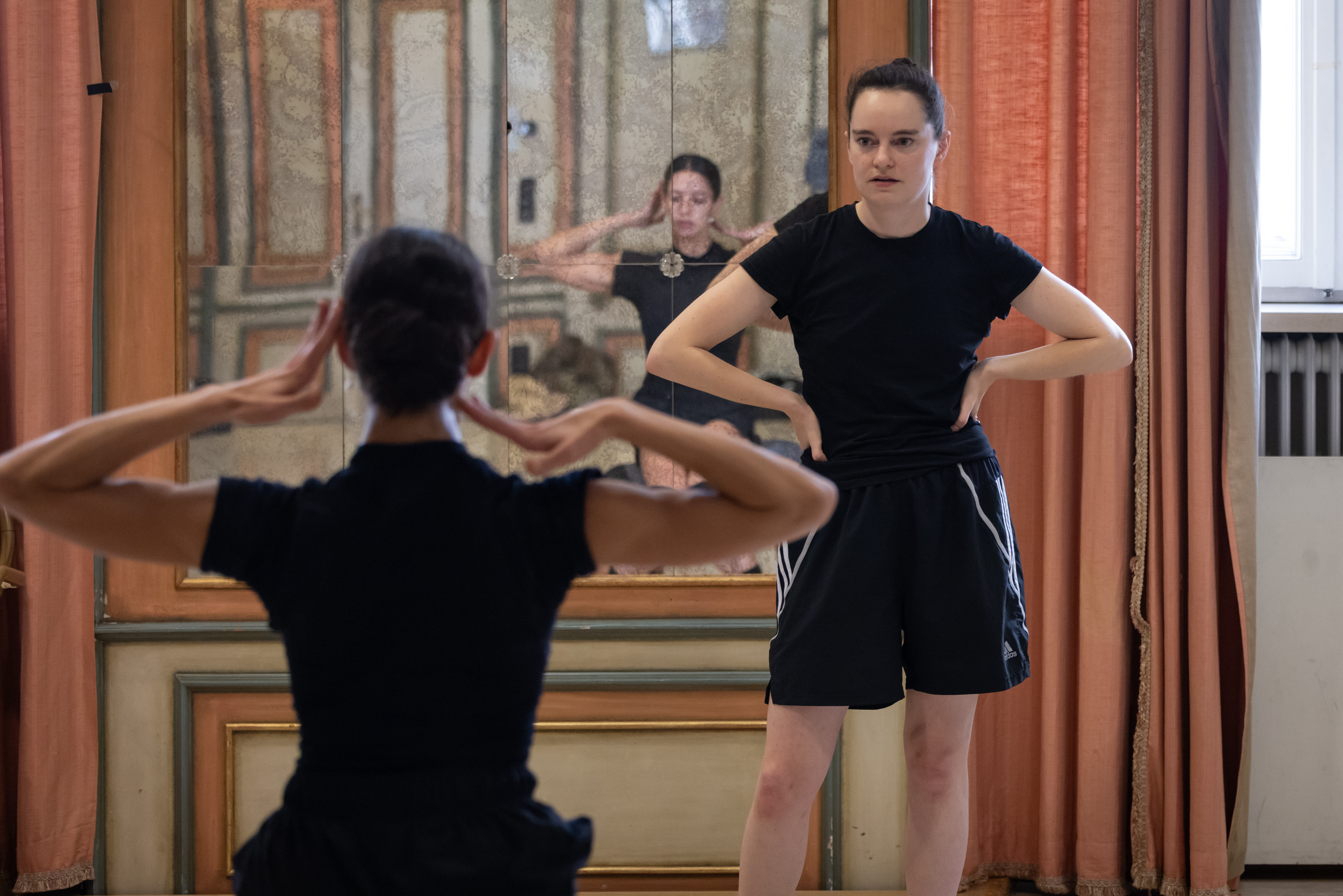
Laughter echoes from the ballet studio on the second floor of the ballet rehearsal building on Platzl. Emma Portner, 31 years young, is working on her creation for the Bayerisches Staatsballett. Wearing black sweatpants and a black T-shirt, her face framed by black glasses, she watches with intense concentration as the ensemble members conjure up her suggested movements on the dance floor.
Megahertz is the name of the new work for a total of seven dancers. It is based on the similarly titled I Trawl The Megahertz by Paddy McAloon. The nearly 23-minute piece of music is composed of orchestral passages and a text collage spoken by a female voice. “It's the perfect container for a ballet,” says Emma Portner. She didn't have to search long for it. “The song basically found me. I heard it on the radio a few years ago while having breakfast and immediately thought, ‘You have to make a ballet to this.’”
She now has the opportunity to do so in Munich. Ballet director Laurent Hilaire has commissioned the young Canadian. He had wanted to recruit her for a creation for some time, but had to wait two and a half years before Portner found a gap in her calendar. After all, her name has become known not only to music video producers, through whom Portner first made a name for herself, but also to dance companies.
The starting point for Megahertz is the voice that episodically shares memories, life episodes, and interpersonal encounters of a female self with us. In the Rosen-Saal in the ballet rehearsal hall on Platzl, this voice is Carollina Bastos. She lends her body and expressiveness to the female memory, writhing on the floor and performing minute movements with her fingers, hands, head, and other body parts in a matter of seconds, which would leave anyone outside the ballet world hopelessly knotted up in themselves in a matter of breaths.
A little later, the other six dancers join them. Once again, laughter echoes through the studio. The search for and discovery of new movement sequences, some of which are as organic as they are unusual for classical ballet dancers, produces some funny moments. “Just try,” recommends Emma Portner, “yes, much better, tomorrow it will be perfect.”
Portner is unmistakably a 21st-century choreographer and a child of her generation. The atmosphere in the ballet studio is one of great respect and trust, with everyone meeting on equal terms. The mutual responsibility and great desire to create together is visible and palpable. Yet her career path is very different from what is usually seen in this profession.
She discovered choreography as a teenager through video clips on the internet. During the snowy Canadian winters, she sat at home and watched what was happening outside in the wide world of dance. Not the theater as a source of inspiration, but social media.
Of course, she also danced. First as a child in her hometown of Ottawa, Ontario. Later, she attended summer courses at the National Ballet of Canada in Toronto. After a few months at the Ailey School in New York City, she turned her professional focus to choreography. She designed movement sequences for music videos, worked with Justin Bieber, and collaborated on projects at the Guggenheim Museum in New York and the Fondation Bayeler in Basel. Since 2020, she has also been working with classical ballet companies. Her piece Megahertz is the first she has created for a German company.
She knew very quickly who she would work with. She came to Munich last season to check out the company. She observes the dancers in their everyday lives, how they come to the studio and talk to their colleagues. And then 10 minutes of the daily class are enough: “I look at a barre in the ballet studio. Usually, I know within a few exercises who I want to work with. Because anyone who can sell a ballet barre with these repetitive sequences and make them seem magical can make anything look magical.”
The members of the Staatsballett who will transform Emma Portner's movements into magic are Carollina Bastos, Severin Brunhuber, Jakob Feyferlik, Ana Gonçalves, Osiel Gouneo, Marina Mata Gomez, and Soren Sakadales. In the final days of rehearsals before the premiere, the participants continue to refine the magic of the choreography, the space, and the lighting. The result will be revealed on December 21 during the premiere of Waves and Circles at the National Theater.
-Annette Baumann
Editorial: Portrait Emma Portner
Emma Portner: Eine neue weibliche Stimme im Ballett des 21. Jahrhunderts
Aus dem Ballettsaal im 2. Stock des Ballettprobenhauses am Platzl tönt leises Lachen. Emma Portner, 31 Jahre jung, arbeitet an ihrer Kreation für das Bayerische Staatsballett. Mit schwarzer Jogginghose und schwarzem T-Shirt, das Gesicht eingerahmt von einer ebenfalls schwarzen Brille, verfolgt sie höchst konzentriert, was die Ensemblemitglieder von ihren Bewegungsvorschlägen auf den Tanzteppich zaubern.
Megahertz heißt das neue Werk für insgesamt sieben Tänzerinnen und Tänzer. Es basiert auf dem ähnlich lautenden Titel I Trawl The Megahertz von Paddy McAloon. Das knapp 23-minütige Musikstück ist zusammengesetzt aus orchestralen Passagen und einer von einer weiblichen Stimme gesprochenen Textcollage. „Es bildet den perfekten Container für ein Ballett“, so Emma Portner. Lange danach suchen musste sie nicht. „Der Song hat quasi mich gefunden, ich hörte ihn vor einigen Jahren beim Frühstück im Radio und dachte sofort, darauf müsste man ein Ballett machen.“
Gelegenheit dazu hat sie jetzt in München. Ballettdirektor Laurent Hilaire hat die junge Kanadierin beauftragt. Schon länger wollte er sie für eine Kreation gewinnen, doch er musste zweieinhalb Jahre warten, bevor Portner eine Lücke im Kalender fand. Schließlich hat sich ihr Name nicht nur bei Produzenten von Musikvideos, über die Portner zunächst bekannt wurde, sondern mittlerweile auch bei Tanzcompagnien herumgesprochen.
Ausgangspunkt von Megahertz ist die Stimme, die uns episodisch an Erinnerungen, Lebensepisoden und zwischenmenschlichen Begegnungen eines weiblichen Ichs teilhaben lässt. Im Rosen-Saal im Ballettprobenhaus am Platzl ist diese Stimme Carollina Bastos. Sie leiht der weiblichen Erinnerung ihren Körper und ihre Ausdruckskraft, windet sich am Boden und vollführt in Sekundenschnelle kleinteiligste Bewegungen mit Fingern, Händen, Kopf und anderen Körperteilen, die jeden Menschen außerhalb der Ballettwelt in wenigen Atemzügen hoffnungslos in sich selbst verknoten ließen.
Wenig später kommen die anderen sechs Tänzerinnern und Tänzer dazu. Wieder dringt Lachen aus dem Studio. Das Suchen und Finden neuer Bewegungsabläufe, die teils ebenso organisch wie aber auch ungewöhnlich für klassische Balletttänzerinnen und Tänzer sind, bringt so einige lustige Momente hervor. „Just try“, empfiehlt Emma Portner, „ yes, much better, tomorrow it will be perfect.”
Portner ist unübersehbar eine Choreographin des 21. Jahrhunderts und ein Kind ihrer Generation. Sehr respekt- und vertrauensvoll geht es zu im Ballettsaal, man begegnet sich auf Augenhöhe. Die gegenseitige Verantwortung und die große Lust am Gemeinsam-Kreieren ist sicht- und fühlbar. Dabei ist ihr Werdegang ein ganz anderer, als der, den man sonst von diesem Berufsfeld kennt.
Zur Choreographie kam sie bereits als Jugendliche über Videoclips im Internet. In den verschneiten kanadischen Wintern saß sie daheim und schaute sich an, was es draußen so gab in der weiten Welt des Tanzes. Nicht das Theater als Inspirationsquelle, sondern Social Media.
Getanzt hat sie aber natürlich auch. Zunächst als Kind in ihrer Heimat Ottawa, Ontario. Später besuchte sie die Sommerkurse des National Ballet of Canada in Toronto. Nach einigen Monaten an der Ailey School in New York City wandte sie sich beruflich schon der Choreographie zu. Sie entwarf Bewegungssequenzen für Musikvideos, arbeitete mit Justin Bieber und wirkte an Projekten des Guggenheim Museums in New York und der Fondation Bayeler in Basel mit. Seit 2020 arbeitet sie auch mit klassischen Ballettcompagnien. Ihr Stück Megahertz ist das erste, das sie für eine deutsche Compagnie kreiert.
Mit wem sie es erarbeiten würde, das wusste sie sehr schnell. Bereits in der letzten Spielzeit ist sie nach München gekommen, um sich die Compagnie anzuschauen. Sie beobachtet die Tänzerinnen und Tänzer im Alltag, wie sie ins Studio kommen und mit Kollegen reden. Und dann reichen 10 Minuten des täglichen Trainings: „Ich schaue mir eine Stange im Ballettsaal an. Meistens weiß ich innerhalb weniger Übungen, mit wem ich arbeiten möchte. Denn wer eine Ballettstange verkaufen und die immer gleichen Bewegungsabfolgen magisch wirken lassen kann, der kann alles verkaufen.“
Die Staatsballettmitglieder, die Emma Portners Bewegungen in Magie verwandeln, sind Carollina Bastos, Severin Brunhuber, Jakob Feyferlik, Ana Gonçalves, Osiel Gouneo, Marina Mata Gomez und Soren Sakadales. In den letzten Probentagen vor der Premiere feilen sie weiter an der Choreographie, am Raum und am Licht und am Miteinander von all diesen Bühnenelementen. Das Ergebnis wird am 21. Dezember im Rahmen der Premiere von Waves and Circles im Nationaltheater zu erleben sein.
-Annette Baumann