Welcome Violetta Keller and Elisabeth Tonev
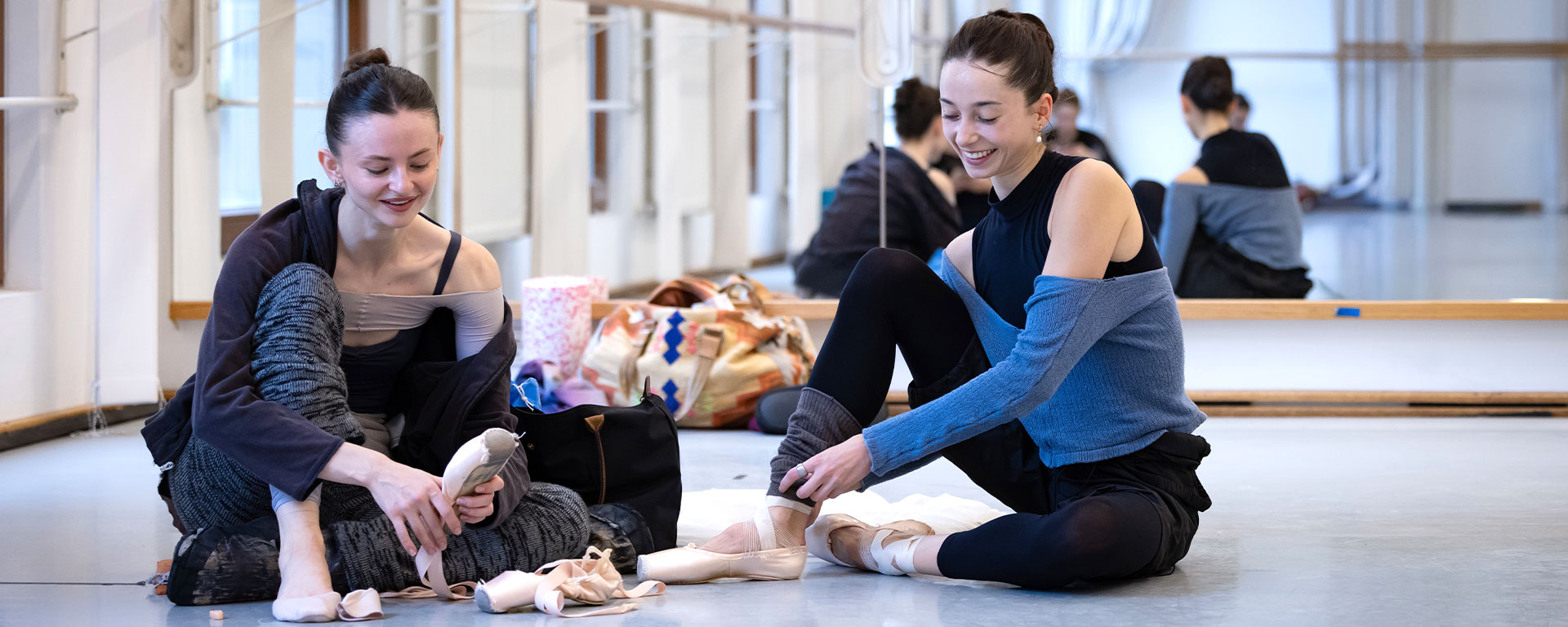
New female power at the helm of the Bayerisches Staatsballett
German dancers at the helm of ballet companies are rare. The Bayerisches Staatsballett now has two: Violetta Keller and Elisabeth Tonev have moved to Munich as Principal Dancers for the 2025/26 season. They will introduce themselves to Munich audiences for the first time in The Nutcracker in November 2025. Over a cup of tea, they look ahead to the season ahead, talk about wild curls, insects and the necessity of doing nothing, and question the phenomenon of social media in dance.
Elisabeth, you trained at the State Ballet School in Berlin and then went to Amsterdam to join Het Nationale Ballet. Now you're moving to Munich. What brought you to the Bayerisches Staatsballett?
E.T. It all came about when I was awarded the Konstanze Vernon Prize here in Munich last year. That was when I first came into contact with Laurent Hilaire and found out that he was interested in me. Until then, I hadn't even thought about changing, I was happy in Amsterdam. But after six years at Het Nationale Ballet, I felt like doing something new. Laurent Hilaire was ultimately the deciding factor. His passion for ballet is simply incredible and I share many of his visions. I immediately had confidence in him and also in the company. It felt right to return to Germany.
Violetta, you also joined the Bayerisches Staatsballett as a new principal dancer for the 2025/26 season. What does this step mean for you as an artist, but also for you personally?
V.K. Growth. For me, this is the next step. I want to broaden my horizons, both personally and artistically. I spent seven years with the Finnish National Ballet in Helsinki, and now it's time for something new for me too. The Bayerisches Staatsballett stands for great choreographic diversity. Even as a student at the Ballet Academy in Munich, it was my dream to one day stand on this stage. And Laurent Hilaire was also a decisive factor for me. I hold him in high regard, both as a dancer and as a director.
What are you most looking forward to this season? Are there any personal highlights?
E.T. The whole season is a highlight. This season's repertoire is incredible, every ballerina's dream. I'm a big fan of dramatic, emotional roles. I like dying on stage (laughs). And I'm looking forward to John Neumeier's ballets, especially The Lady of the Camellias. I haven't danced any Neumeier ballets yet.
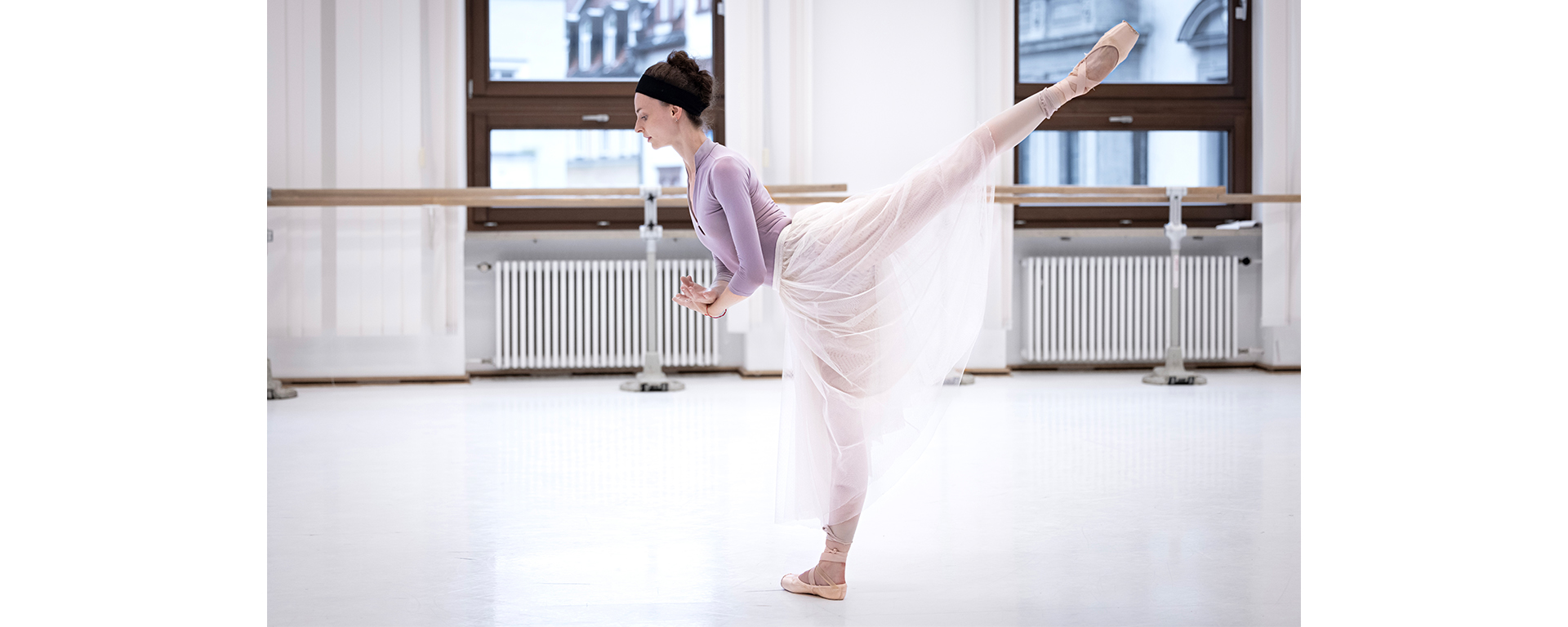
After the guest performance of Giselle in Barcelona, the company will start the new season in Munich with John Neumeier's The Nutcracker. You have both danced this work before in Wayne Eagling's choreography. What is different in Neumeier's version?
V.K. The biggest difference is probably the reinterpretation of E.T.A. Hoffmann's fairy tale. In Neumeier's version, the Mouse King and the entire battle scene that Marie experiences in her dream are missing. Instead, the focus is on presenting ballet as an art form. This is also evident in the role of Louise, which we are currently rehearsing. In Neumeier's version, Louise is Marie's big sister. She is a ballerina who represents the life of a dancer and the world of theatre. In Eagling's version, I danced Clara (equivalent to the role of Marie in Neumeier's version, editor's note). Now I am portraying Louise, who is much more mature. This is also another step forward for me in my dancing career.
Do you have a favourite part in this choreography, Elisabeth?
E.T. The Grand Pas de deux. The choreography is very different from Wayne Eagling's, but really beautiful. It flows, is super organic and, above all, super musical. The solo variation in it is also great. It's even to a different score by Tchaikovsky. Neumeier has chosen an excerpt from Sleeping Beauty here.
Are there any particular technical challenges in Neumeier's version?
E.T.: I think the challenge with Neumeier lies above all in the incredible musicality. Of course, Neumeier is also technically demanding. But on top of that, the choreography is set very precisely to the music and you have to dance very musically.
Ballet is both an art form and a competitive sport. How do you stay fit?
V.K.: Nutrition plays an important role. I make sure I eat the right proteins and carbohydrates. I also go jogging. In Finland, I often used the treadmill, simply because it's too cold outside for many months of the year. In Munich, I enjoy running in the English Garden. And I also do a lot of Pilates.
E.T.: Fitness is very important. But for me, keeping fit doesn't just mean working, working, working until you drop. You have to find the right balance between training and breaks. The older you get, the better you understand your body and the importance of rest at the right time.
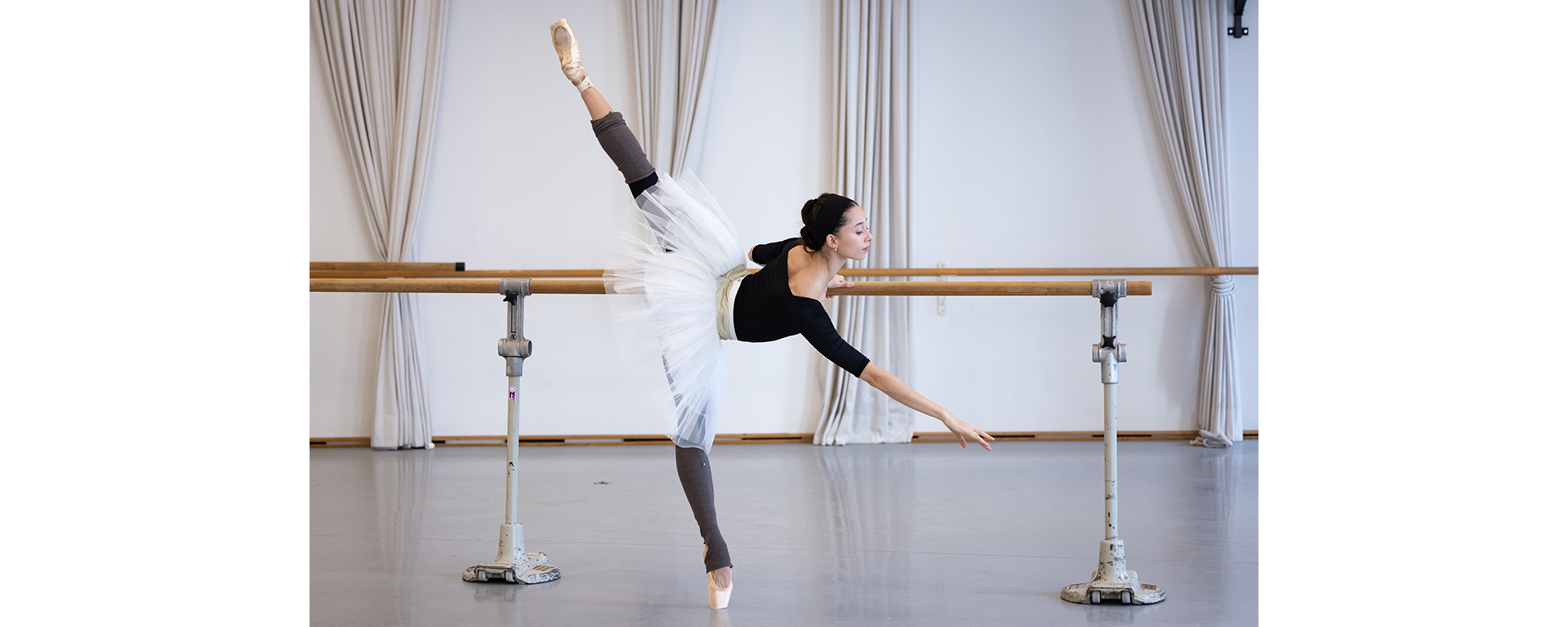
Where can we find you on your day off?
V.K.: Probably in the English Garden, somewhere surrounded by nature. I've loved insects since I was a child. Bees, ants, but especially ladybirds – there are so many different types of ladybirds. And they're so pretty. Butterflies too. I just find insects really interesting.
E.T.: Apart from nature and the mountains, which I find so amazing here and which I don't know from Berlin or Amsterdam, I also like to find inspiration in other areas of art. I enjoy going to the theatre, museums or the philharmonic. I'm really looking forward to discovering all of that here in Munich.
Please complete the sentence ‘My day usually starts with ...’:
V.K.: Funny question: The first thing that comes to mind is my hair. I have quite wild curls, which I have to tame first. It's not enough to just tie it back. So I do my hair first thing in the morning. I don't need coffee in the morning, I'm usually awake anyway (laughs)
E.T.: Hmm, coffee? (laughs). I don't have a routine; every day is different for me. I always check how my body is feeling first and then see what happens.
What advice would you give to young dancers who want to make ballet their profession?
E.T.: The most important thing is not to forget your passion, the reason why you became a dancer. With all the drudgery and hard work involved, it's easy to lose sight of that. But the second thing is exactly that: work hard. Without hard work, it's impossible, no matter how much talent you have. And ultimately, it's about bringing your personality to the stage and sharing your story with the audience.
V.K.: I don't think it can be said often enough that ballet is not just about ballet, about dance. It's about people; about relationships with people. We work with and for each other every day. We grow together. Being a dancer is a very social profession. You always have to keep that in mind. And you can't take ballet too seriously; ballet isn't everything. I mean, you shouldn't destroy yourself for it and get too stuck in your tunnel. Inspiration can be found everywhere. It's important to remain open to everything else, other arts, other perspectives. We also portray different personalities and constantly rediscover ourselves in the process. That's only possible if I don't stay in my bubble.
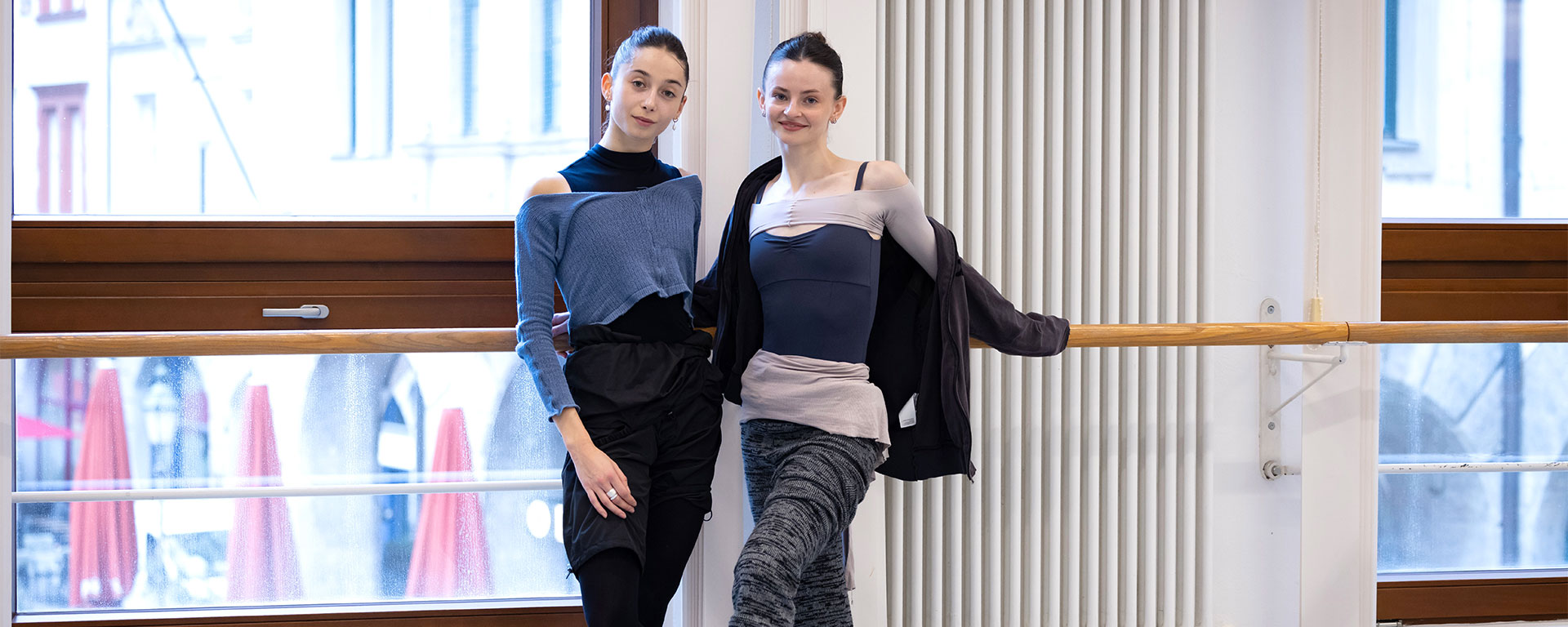
Violetta, your mother is German, your father is from Russia, you grew up in Munich for a long time, but most recently you lived in Finland. We are conducting this interview in English. What language do you think in?
V.K.: I think in the language I am speaking at that moment. That could be German, English or even Russian. Since I have mainly spoken English for the last seven years, my head is currently still tuned to English. But that will certainly change soon.
Elisabeth, it's similar for you: you were born and raised in Berlin, your mother is Spanish, your father is Bulgarian, and you most recently danced in Holland. How does it work for you?
E.T.: It's actually quite similar for me. I automatically switch between languages depending on the environment I'm in or who I'm talking to. Sometimes German, sometimes Spanish, sometimes English, and sometimes a bit of everything mixed together. When I'm in a country for a longer period of time, my head quickly adjusts to the local language. However, since moving back to Germany, I find myself thinking in German more and more often.
Let's stick with nationalities. You are both principal dancers with German passports, and both trained in Germany. That is very rare in the international dance world. Why do you think there are so few German dancers?
E.T. I have often asked myself that question. Violetta and I also see it as our responsibility to be role models. Perhaps art and artistic expression no longer play such an important role for the younger generation today because other things have become more important. There are so many office jobs, there is social media. It could be that these many new developments are causing people to lose their artistic side.
Speaking of social media: What role do social media play in dance today?
E.T. I think social media are a good network. Dancers today have much more contact with each other than they used to, you get to see a lot more and the ballet community has become closer. But social media will never be able to replace a live performance. The emotionality of dance can never come across digitally in the same way as it does live on stage. You can't capture that passion with a camera. Also because the connection to the audience, that immediacy, is lost. Besides, on social media you usually only see half the truth. Only the great things are posted, the fantastic rehearsals or performances. You don't get to see the hard work that goes on in everyday life. In that sense, social media is always a bit of an illusion.
Last question for Violetta: How does it feel when the curtain rises and the applause breaks out at the end of the performance?
V.K. Reality. When you're on stage, you're a different person in a different world. It's incredibly important to me to really feel the roles and live them. On stage, I'm a different person, a different character. As soon as you step in front of the curtain to take your bow, you become yourself again. You become the artist receiving the applause. Apart from that, I also feel gratitude, joy and happiness that the work I have done is appreciated by the audience. Yes, it's happiness.
Violetta, Elisabeth, thank you very much for this interview!
The questions were asked by Annette Baumann.