THE LADY OF THE CAMELLIAS
Choreography John Neumeier. Music Frédéric Chopin.
recommended for 12 years and olderDuration est. 2 hours 55 minutes

Choreography John Neumeier. Music Frédéric Chopin.
recommended for 12 years and olderDuration est. 2 hours 55 minutes
Alexandre Dumas’s epochal novel La dame aux camélias became the template for both operas (La traviata) and numerous films and ballets. John Neumeier created his version of the material in 1978 for Marcia Haydée and the Stuttgart Ballet.
Neumeier relates the harrowing tale of the courtesan Marguerite Gautier suffering with lung disease, and the young Armand who has fallen for her, in the tightest choreography and with unprecedented dramaturgical finesse, oriented on cinematic structures.
Into the equation comes the music by Frédéric Chopin, whose romantic virtuosity and existential forlornness completely stamps the seal of deepest truthfulness on the ballet. Chopin’s Piano Concerto No. 2, the romance from his Piano Concerto No. 1, the Grande Fantasie op. 13 and the Grande Polonaise brillante op. 22 are complemented by pure piano compositions, such as the Ballade in G minor op. 23, Préludes No. 2, 15, 17 and 24 from op. 28, Waltz No. 1 and Waltz No. 3, as well as the Trois Ecossaises from op. 72. The Largo from the Sonata in B minor op. 58, which appears at dramaturgically critical points, forms a musical bracket here.
Neumeier also skilfully picks up on a motif from the original novel by reflecting Marguerite and Armand’s wretched fate in the “stage fate” of two other novel characters from an earlier century – Manon Lescaut and her lover, Des Grieux. Since the world premiere of Neumeier’s work the main roles rank among the most coveted roles of the great dance actors, who find in them challenging dance technique tasks and incomparable possibilities, to immerse themselves in the most differentiated characters conceivable.
The ballet takes place during an auction. The action unfolds as a series of flashbacks remembered from diverse points of view— Armand’s, his father’s and Marguerites’. All actions happening in the present, that is during the auction, are indicated by italics
Prologue
March 1847, rue d’Antin No 9
Marguerite Gautier, one of the most desirable courtesans in Paris, has died. To pay her debts, post-mortem, luxurious personal belongings as well as the sumptuous furnishings of the apartment are to be disposed of by auction. Nanina, Marguerite’s devoted servant, enters —carrying her mistress’s diary which she has promised to deliver to Armand. She bids a sad farewell to the apartment just as curious visitors arrive to inspect the lavish inventory. Between the busy auction workers we recognize figures from Marguerite’s past—the Duke, her confidant Prudence, the young Count N. and the courtesan Olympia. Also present is an older man, Monsieur Duval, whose son Armand suddenly rushes breathlessly into the room. Overcome by his memories of Marguerite he collapses.
Act I
While his father calms and consoles him, Armand, sparked by seeing the violet gown Marguerite wore at their first meeting, tells his story:
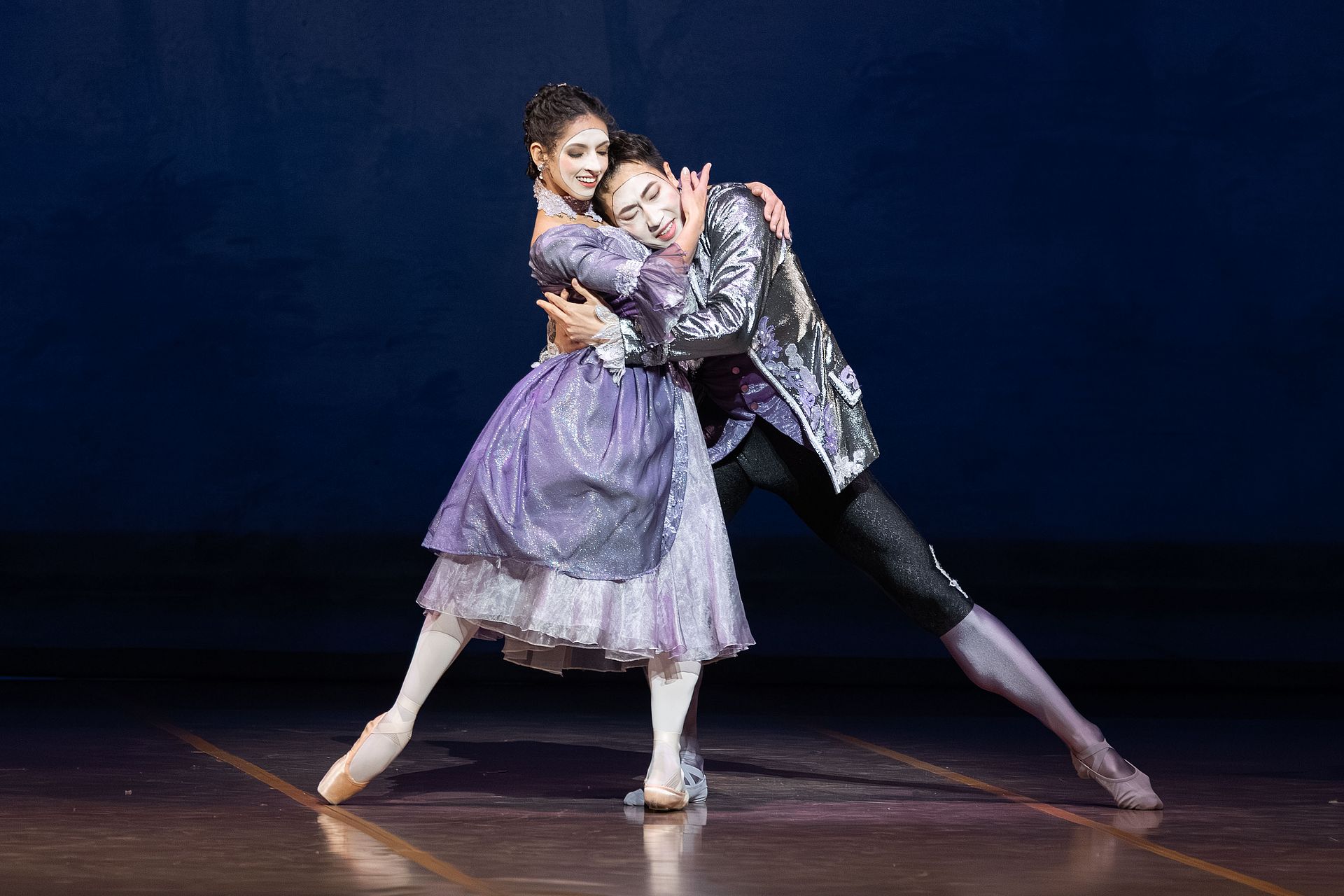
It begins in the Théâtre des Variétés during a performance of the ballet “Manon Lescaut” which humorously presents the caprices of the famous rococo courtesan deceiving her lover Des Grieux with numerous admirers. In the audience, Marguerite Gautier is disgusted by Manon’s frivolous infidelity. Armand Duval, who has long admired Marguerite, is introduced to her by Gaston Rieux. Marguerite mocks Armand’s awkward sincerity. As he follows the comic ballet, Armand fears that his own future may reflect Des Grieux’s sorrowful fate. Unexpectedly, after the performance Marguerite invites Armand to her apartment together with Gaston, Prudence, and the wearisome young Count N., her escort of the evening. Later, annoyed by the unwelcome advances of the jealous Count, Marguerite suffers a severe attack of her fatal disease—consumption.
Unable to control his concern for Marguerite, Armand spontaneously rushes after her, offering his assistance and then confessing his profound love. At first amused, Marguerite slowly becomes moved by his shinning optimism and the sincerity of his ardent passion. However, always aware of her fatal illness and the consequent need for the comforts of luxury, she insists that she cannot change her life and therefore their affair must remain secret.
Continuing her frantic life, Marguerite hastens from one ball to another, from one lover to another— but, Armand may always be there - waiting…
When Marguerite departs for the country house the Duke has put at her disposal, Armand follows her.
Act II
Discovering the straw hat that Marguerite wore that summer, Armand resumes his story…
In the country, surrounded by reveling friends and fervent admirers, Marguerite continues her turbulent lifestyle. However, with the Duke’s arrival and his inevitable confrontation with Armand, Marguerite’s moment of decision arrives. She publicly acknowledges her love for Armand.
Armand and Marguerite are alone. Time seems to stand still…
Armand’s father recalls with regret his part in the story.
Unknown to his son, Monsieur Duval visits Marguerite in the country. Ashamed that Armand is living with a prostitute, he insists that their relationship will ruin Armand and his family. Shocked, Marguerite vehemently protests. She then desperately pleads. But, a vision of Manon appears, recalling Marguerite’s own past and confirming the truth of Monsieur Duval’s accusations. He demands that she leave Armand Immediately. Because of her profound and sincere love for Armand Marguerite complies.
Armand tells his father how, returning from riding with friends, he found the house deserted.
He waited. Then, Nanina brought him a letter from Marguerite saying that she had returned to Paris and to her former life. Unbelieving, Armand runs to Paris, finding Marguerite in the arms of the Duke.
Act III
Armand relates to his father how he later met Marguerite on the Champs-Élysées.
Marguerite was accompanied by the Count N. and the beautiful young courtesan Olympia. Seeking only to hurt the woman who had so deeply wounded him, Armand flirts with and seduces Olympia.
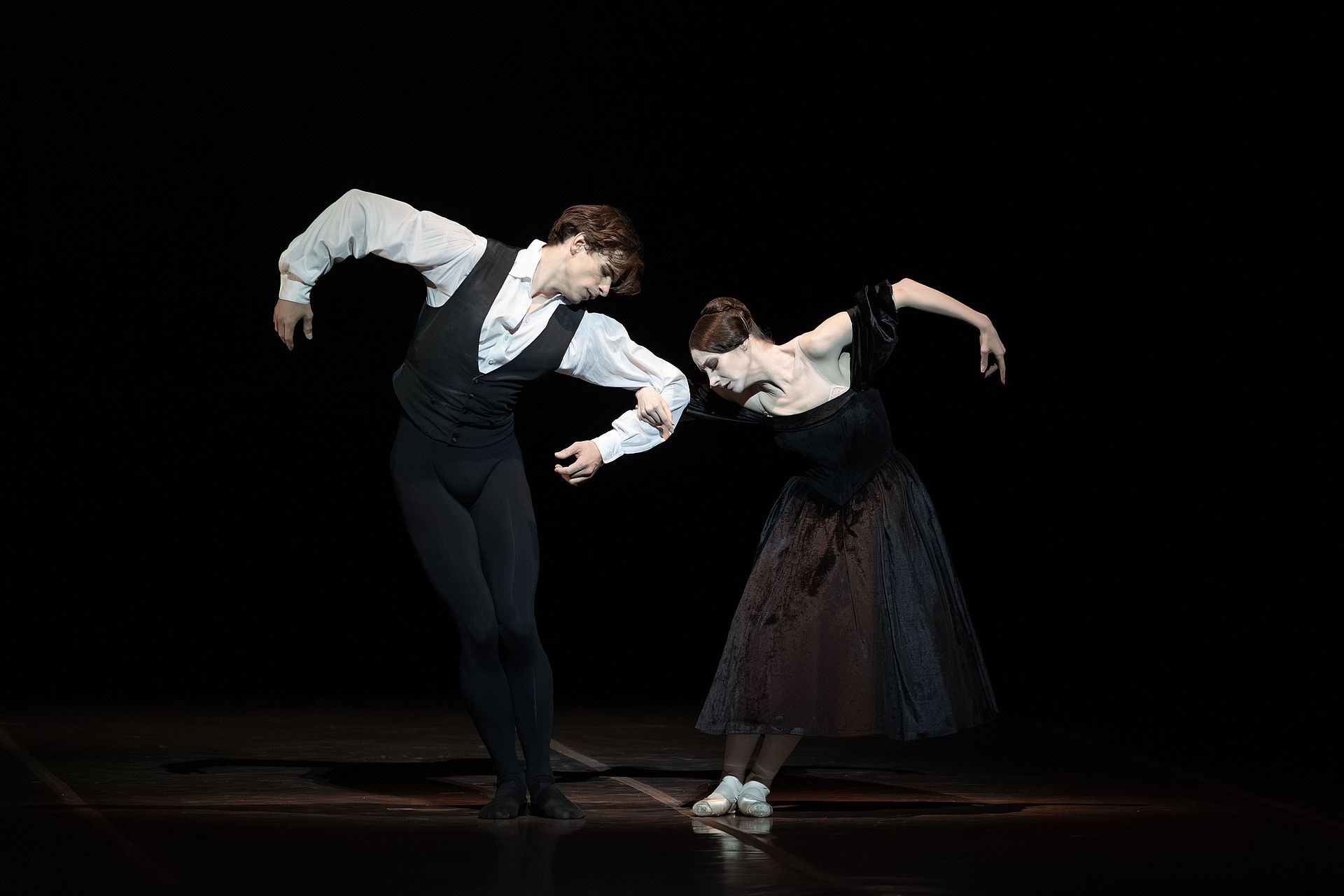
Deathly ill, Marguerite visits Armand, begging him not to continue hurting her by flaunting his affair with Olympia. Their confrontation ignites once more their profound love and leads to a night of intense feverish passion. In sleep, a vision of Manon seems to beckon Marguerite back to her former life. Waking, she remembers her promise to Armand’s father and leaves Armand again.
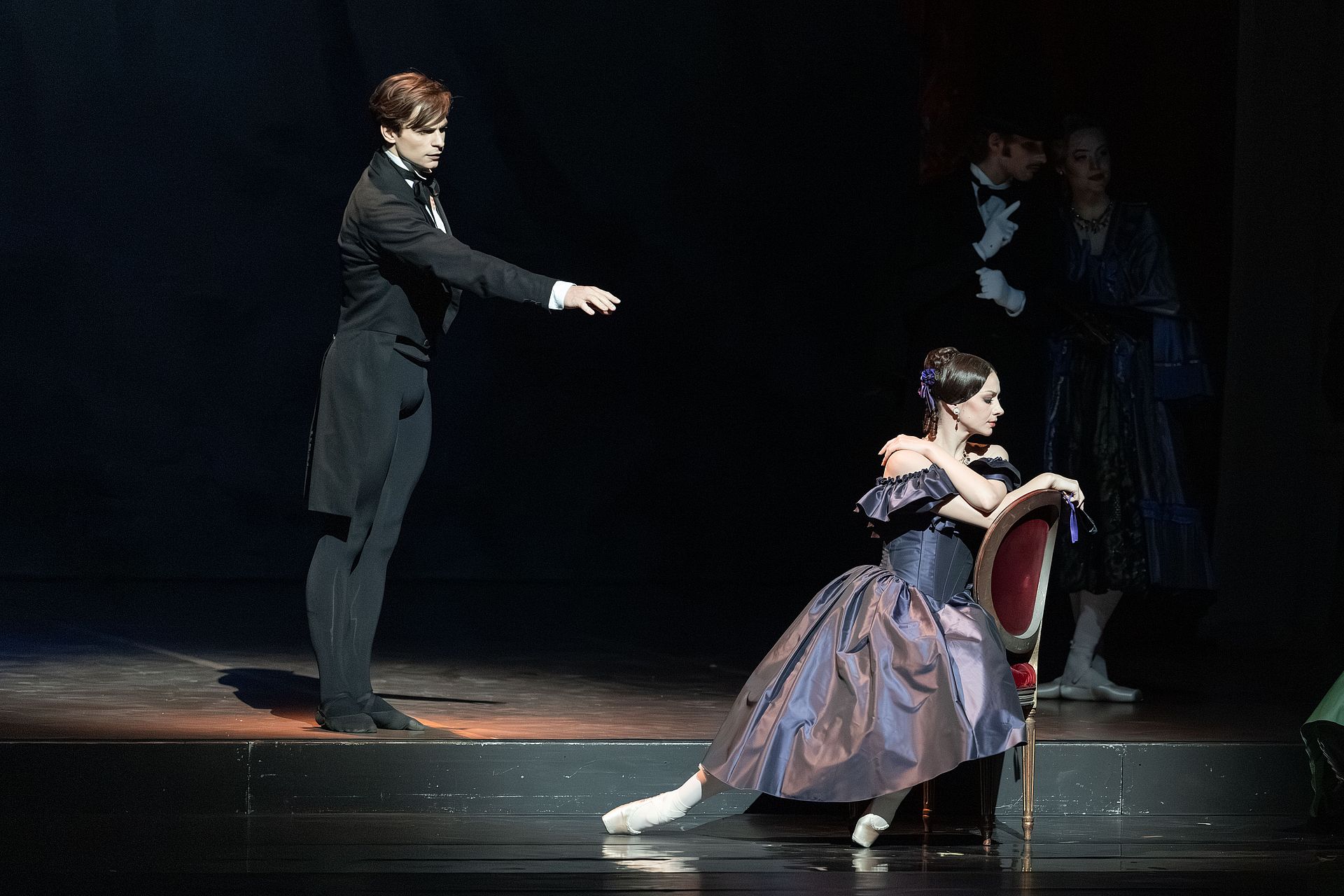
The duke accompanies Marguerite to a “Golden Ball”. Armand, who is also present with Olympia, publicly humiliates Marguerite by giving her money as “payment” for past services. Marguerite collapses.
Armand has reached the end of his story. Deeply moved, his father leaves, just as Nanina enters and gives Armand Margaret’s diary.
Reading, Armand seems to accompany Marguerite on her last visit to the theatre.
As she stares at the chair where Armand sat during their first meeting, Marguerite again experiences the ballet “Manon Lescault”. This time it is the last scene in which Manon, impoverished and lost in the desert, dies in the arms of her faithful lover Des Grieux.
Desperately ill, Marguerite leaves the Theater—but the characters from the ballet follow her in a feverish dream. As the phantom lovers blend with her own memories, her identification with Manon seems complete.
Deserted and longing for Armand, Marguerite confides her last expressions of love to the diary which she entrusts to Nanina to deliver to Armand.
Marguerite dies alone.
Armand silently closes her diary.





Die Kameliendame (Programm)

Die Kameliendame (Plakat)

